
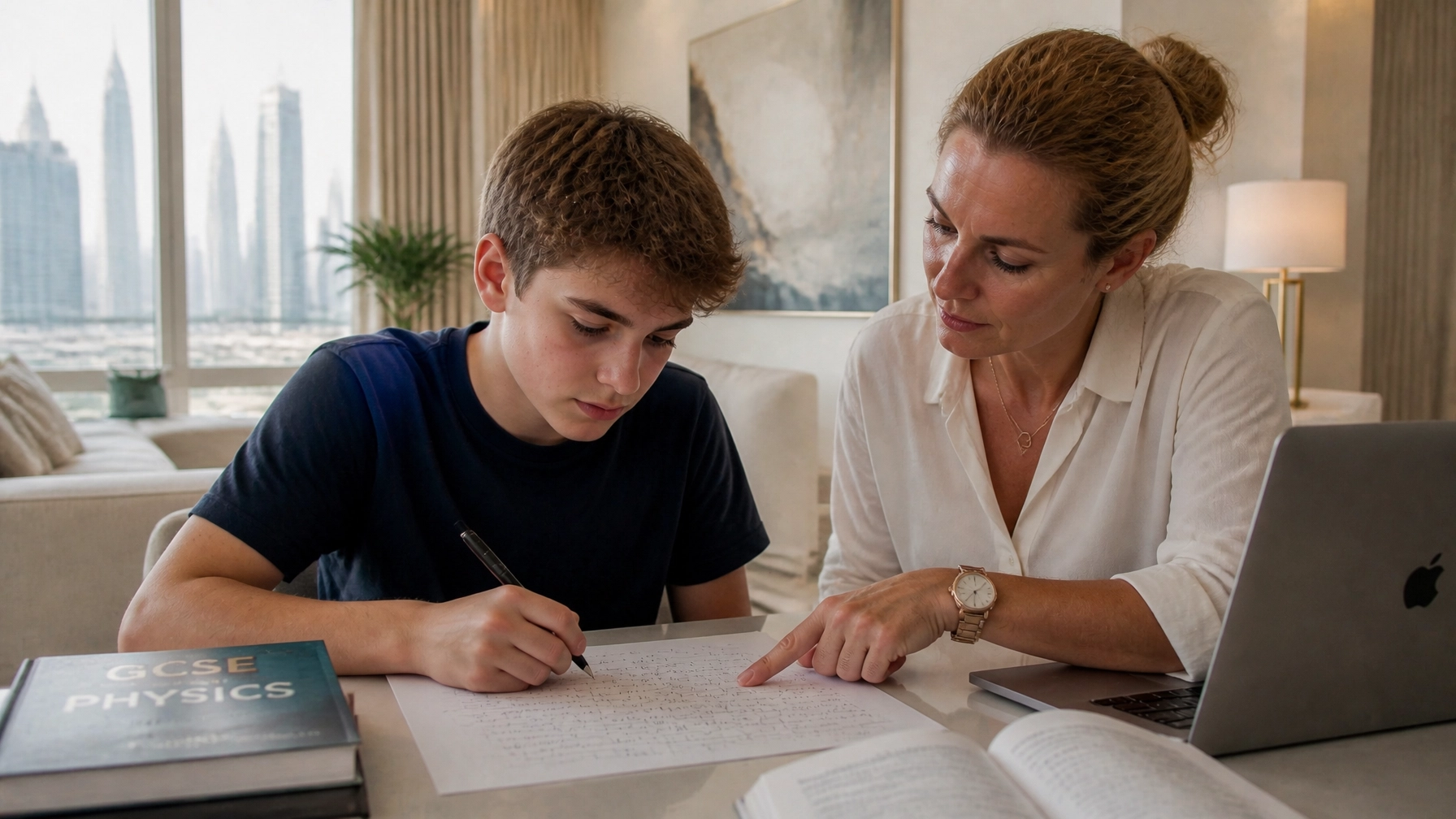
For parents of GCSE students, there's a recurring source of frustration that often surfaces after a mock exam or a mid-term test. It's the "Performance Paradox": a student spends six hours on a Sunday afternoon "revising," yet their marks stay the same. They've used the highlighters, they've read the textbook, and they've watched the videos. By all traditional metrics of "effort," they should be succeeding.
However, in the science of learning, effort isn't always synonymous with progress.
This gap often comes down to a fundamental misunderstanding of how the human brain stores and retrieves information. Most students default to passive revision: methods that feel productive but lack the cognitive "friction" required to build long-term memory.
To move the needle in high-stakes subjects like GCSE Maths and GCSE Science, students must transition to active recall.
The Illusion of Knowing: Why Passive Revision Fails
Passive revision is the process of putting information into your brain. This includes reading notes, highlighting key passages, or watching a tutorial on YouTube.
The danger of these methods is what psychologists call the "fluency illusion." When a student re-reads a chapter on cell biology, the information starts to look familiar. The brain recognises the words on the page and provides a false sense of security.
But in an exam hall, the textbook is closed. The student is no longer asked to recognise information; they are asked to retrieve it from scratch and apply it to a novel problem. If they've never practiced the act of retrieval, the brain can come up empty.

Active Recall: The "Testing Effect"
Active recall is the deliberate act of pulling information out of your brain. Testing yourself without looking at your notes.
Research into evidence-based revision methods for GCSEs consistently shows that this "struggle" to remember is exactly what strengthens the neural pathways. Every time a student forces themselves to remember the formula for kinetic energy or the steps of mitosis, they're telling their brain that this information is important and needs to be accessible.
Studies have shown that retrieval practice can produce 50–80% more retention than passive methods for the same amount of study time.
How to Use Active Recall for GCSE Science
Science subjects at GCSE require a blend of factual recall (definitions, labels) and process understanding (how a heart pumps, how a reaction occurs).
1. The "Blurt" Method (Brain Dumps)
This is one of the most effective ways to identify gaps in knowledge.
- A student chooses a topic (e.g., "The Periodic Table" or "Photosynthesis").
- They set a timer for 10 minutes and write down every single thing they can remember on a blank piece of paper. No notes allowed.
- Once the timer is up, they open their textbook and use a different coloured pen to fill in the gaps they missed.
The red ink (the missed parts) becomes the immediate focus for the next session. This ensures they aren't wasting time on what they already know.
2. The Feynman Technique
Named after the physicist Richard Feynman, this involves explaining a concept in simple terms, as if teaching a younger sibling. If a student can’t explain the difference between ionic and covalent bonding without using jargon, they haven’t fully grasped it.
The act of "teaching" forces the brain to organise information logically.

Active Recall in GCSE Maths: Beyond the "Worked Example"
Maths revision is often the biggest casualty of the fluency illusion. Students will often watch a teacher solve a quadratic equation on a screen, feel they understand, and move on.
In GCSE Maths, the only way to perform active recall is through deliberate practice.
1. The "Open-Book" Trap
If a student keeps their notebook open while doing practice questions, they are still doing passive revision. They are "referring" rather than "recalling." True active recall in maths happens when the student attempts the question entirely from memory. Even if they get stuck on the first step, the mental effort of trying to find the starting point is more valuable than immediately looking at a hint.
2. Interleaving (Mixed Practice)
Most textbooks are organised into blocks: 20 questions on Pythagoras, then 20 on Trigonometry. This allows the brain to "autopilot."
Interleaving involves mixing different topics into a single session. By jumping from a geometry question to a probability question, the student has to actively decide which formula to use. This mirrors the reality of a GCSE paper, where questions don't come with a "topic header."
The Performance Paradox: Why Students Resist Active Recall
If active recall is so much more effective, why do most students avoid it?
The answer is simple: it feels harder.
Passive revision feels easy and comfortable. It gives the "warm glow" of familiarity. Active recall, by contrast, exposes what you don't know. It's frustrating to sit in front of a blank "blurt" sheet and realise you can only remember three things about OCR Biology.
However, this frustration is a sign of learning. High-performance students learn to lean into this discomfort because they know that the "struggle" in the bedroom or the classroom is what prevents a "struggle" in the exam hall.
The Missing Link: Spaced Repetition
Active recall is powerful, but it's not a "one-and-done" solution. To move information from short-term memory to long-term "mastery," it must be repeated at specific intervals. This is known as Spaced Repetition.
Instead of revising AQA Physics for five hours on a Monday and never looking at it again, a student should test themselves on Monday, then again on Thursday, then again the following week. This prevents the "forgetting curve" from taking hold.

How Parents Can Support the Shift
Transitioning from passive to active revision requires a change in habits, which can be difficult for a teenager to manage alone while balancing 10 different subjects.
As a thinking partner to your child, you can help by:
- Shifting the focus from "Time Spent" to "Topics Mastered": Instead of asking "How long did you study?", ask "Show me your blurt sheet for Organic Chemistry."
- Encouraging Low-Stakes Testing: Help them with flashcards or ask them to explain a concept to you while you're driving or having dinner.
- Focusing on Systems: Help them build a calendar that accounts for spaced repetition, rather than just "cramming" for the next test.
In our model at Princeps Education, we believe that academic success is as much about the system as it is about the subject. This is why every student is supported not just by a British-qualified Subject Tutor, but by a Lead Educator (Head of Progress). While the tutor ensures the student understands the complex science or maths concepts, the Lead Educator builds the active recall systems, tracks the spaced repetition schedule, and ensures the student isn't falling back into the "passive revision trap."
By focusing on the science of how we learn, we remove the guesswork and the stress, ensuring that every hour of effort translates into measurable academic progress.
To learn more about how we implement science-based learning systems for GCSE students, visit our curriculum overview here.