
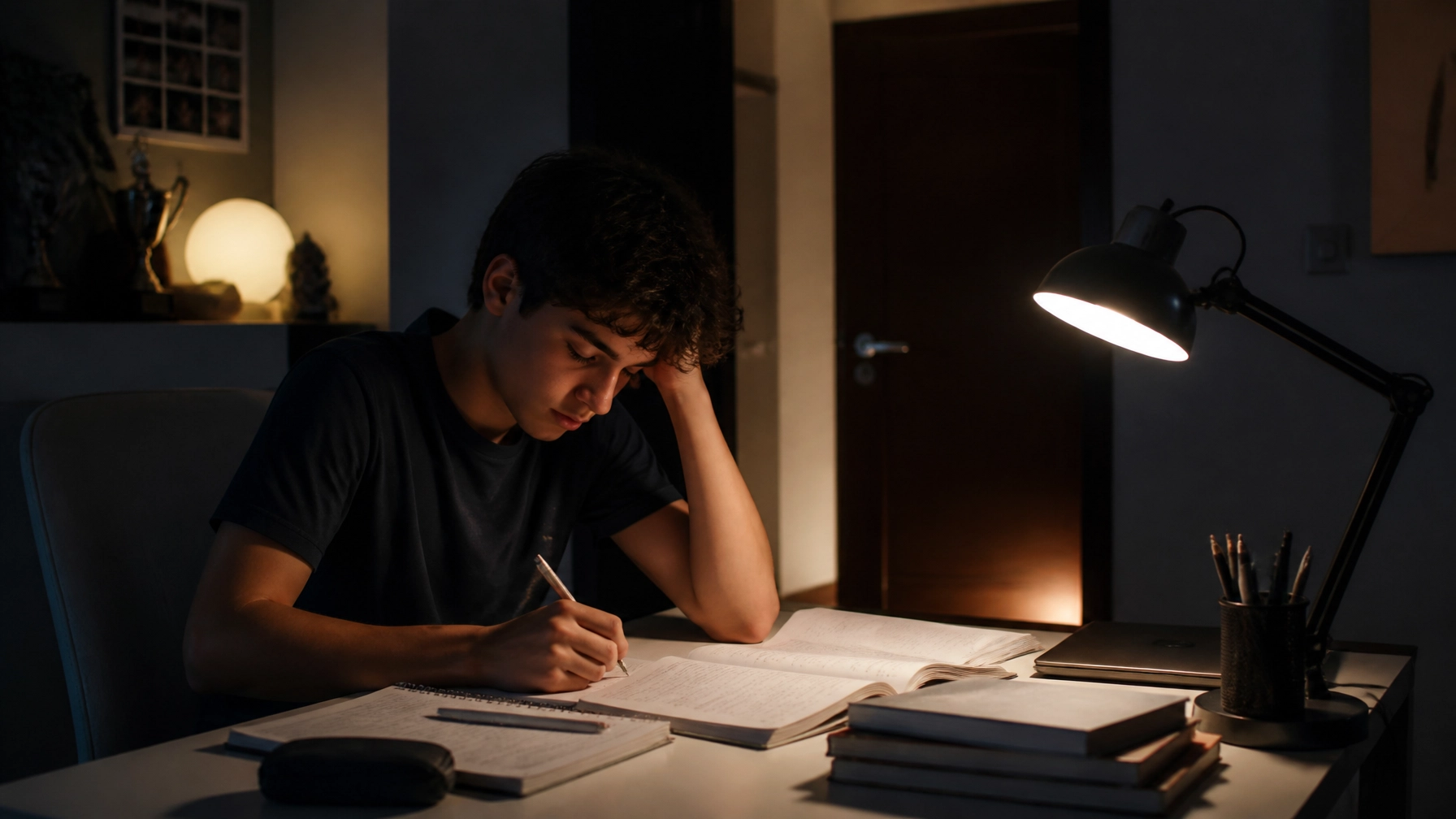
It's 8:30 PM on a Tuesday in Dubai. Through the closed bedroom door, you see a sliver of light. You know your child is in there, presumably preparing for their GCSEs. You find yourself pacing the hallway, caught in a mental loop: Have they done enough? They’ve been in there for three hours, but are they actually working? Should I go in and check?
When you finally do knock, the atmosphere shifts instantly. It's defensive. It's tense. You ask how it’s going; they give a one-word answer. You mention the time, and they snap that they’ve "been at it all night."
This is the Study Desk Standoff. It's a ritual played out in thousands of high-achieving households every evening. It stems from a place of love and a desire for success, yet it often produces the exact opposite: heightened anxiety, fractured relationships, and remarkably little actual learning.
The problem isn't a lack of effort. The problem is that we are measuring the wrong thing.
The Metric Trap: Why Hours Are a Lie
As parents, we crave data. In the professional world, we track KPIs, billable hours, and project milestones. It's only natural that we apply this logic to our children's education. Time spent at a desk is the most visible, measurable metric we have.
However, in the world of cognitive science, "Time-on-Task" is a notoriously poor predictor of exam success.
There is a phenomenon known as Parkinson’s Law, which states that "work expands so as to fill the time available for its completion." If a student believes they must sit at their desk from 6:00 PM to 9:00 PM to satisfy a parental expectation, their brain will subconsciously ensure the work takes exactly three hours. They might spend forty minutes choosing the right highlighter, an hour "re-reading" a chapter while their mind wanders to a weekend plan, and another hour meticulously copying notes that they will forget by morning.
When we monitor hours, we inadvertently encourage performative studying. The student isn't focused on mastering a concept; they're focused on looking busy until the clock runs out.
The Illusion of Competence
The most dangerous part of the Study Desk Standoff is that it feels productive to both parties. The parent sees a child at a desk and feels a sense of relief. The student finishes a four-hour session and feels exhausted, equating that fatigue with "hard work."
This leads to the Illusion of Competence.
Cognitive science shows that passive study methods: like re-reading textbooks or highlighting notes: create a false sense of familiarity. Because the information looks familiar as the student's eyes move across the page, their brain tells them, "I know this."
In reality, they haven't learned it; they've simply recognised it. Recognition is easy; recall is hard. This is the primary reason why many students in competitive Dubai schools perform well in class but struggle when faced with AO3 problem-solving questions or high-pressure exam environments. They've spent hours building an illusion that dissolves the moment the textbook is closed.

The Cortisol Connection: Why Tension Blocks Learning
When the evening becomes a cycle of monitoring and friction, the household's "emotional climate" changes. For a teenager, constant academic surveillance can feel like a vote of no confidence. It triggers a stress response.
When the brain is under stress, it produces cortisol. In small doses, cortisol can help focus. But chronic stress: the kind created by nightly standoffs: actively impairs the hippocampus, the part of the brain responsible for forming new memories.
Essentially, by creating a high-pressure environment to ensure they're "studying enough," we may be physically preventing their brains from retaining the information they're trying to learn. An anxious child is a cognitively compromised child.
This is particularly prevalent among GCSE students in Dubai, where the social and academic stakes are high. When the home becomes another theatre of performance rather than a sanctuary of support, burnout isn't just a risk; it's an inevitability.
Shifting the Goalposts: From Time to Evidence
If monitoring hours is counterproductive, what is the alternative?
The shift must be from Quantity (How long did you work?) to Quality (What is the evidence of your learning?). This requires moving away from the role of a "supervisor" and towards the role of a "thinking partner."
1. The 10-Minute Synthesis
Instead of asking "Have you finished yet?", try asking "What was the most difficult concept you cracked today?" or "Can you explain that diagram to me in sixty seconds?" If they can’t explain it simply, they haven't mastered it. This encourages metacognition: the ability to think about their own thinking.
2. Output-Based Goals
Help your child set goals based on tangible outputs rather than time.
- Weak goal: "I’m going to study Biology for two hours."
- Strong goal: "I’m going to complete three past-paper questions on cell mitosis and check them against the mark scheme."
Once the output is achieved, the session is over: regardless of whether it took thirty minutes or two hours. This incentivises efficiency and focus.
3. The Power of Active Recall
The gold standard of learning is Active Recall. This means closing the book and forcing the brain to retrieve the information from memory. It's mentally taxing and feels much harder than reading, which is exactly why it works. Encourage your child to use "blurting" (writing down everything they remember on a blank sheet) or flashcards.

Restoring the Evening Peace
The goal of education is not just the grade; it's the development of an independent, capable individual. When we stop monitoring the clock, we hand the responsibility of learning back to the student.
This transition is rarely seamless. There may be evenings where they do less than you’d hope. But by removing the friction of the "standoff," you create space for a different kind of conversation: one about strategy, energy management, and genuine curiosity.
When the bedroom door stays open because there is no reason to hide, and when the dinner table conversation shifts from "How many hours?" to "How did you solve that?", the results usually follow. Not because of the pressure, but because the brain is finally free to do its job.
The evening should be a time for the family to decompress, not a second shift of industrial oversight. By focusing on outcomes over hours, you don't just improve their grades; you reclaim your relationship.

Princeps Education provides a premium, science-based approach to British tutoring, focusing on long-term academic mastery through the dual support of a Subject Tutor and a Lead Educator.